Introduction: The Magic from Yarn to Art
1. The History and Cultural Roots of Crochet
The origins of crochet can be traced back to 16th-century Europe, where it began as a practical technique used by fishermen to mend nets. Over time, it evolved into a leisure activity for noblewomen. In the 19th century, the craft declined with the impact of the Industrial Revolution, but the “handicraft revival” of the 1970s brought it back to life. Today, crochet has broken geographical boundaries and become a shared language among craft enthusiasts around the world.
In India, women use colorful cotton yarn to create traditional blankets. In Japan, artists blend crochet with modern design to produce avant-garde installations. In Northern Europe, minimalist crochet pieces pair harmoniously with natural aesthetics. This cultural fusion has elevated crochet beyond practical use, transforming it into a cultural symbol.
2. Techniques: From Basic Stitches to Creative Expression
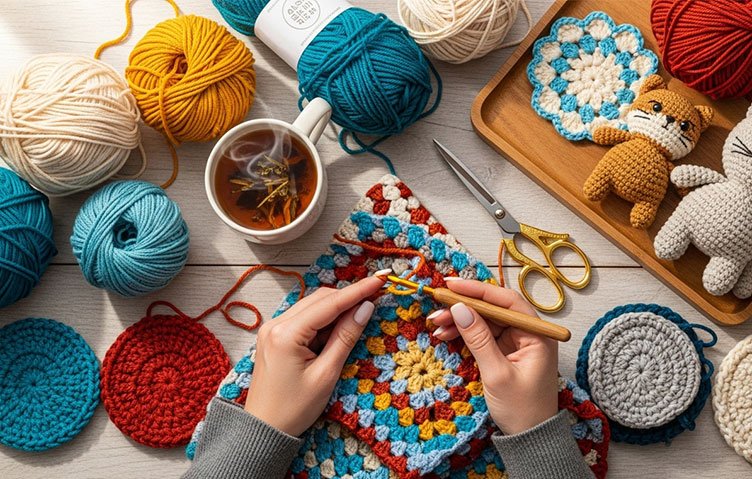
The essence of crochet lies in the combination of “stitches” and “patterns.” Basic stitches include chain stitch, single crochet, and double crochet. Different arrangements of these stitches create various textures. For example, the Afghan stitch is ideal for thick blankets, while the popcorn stitch produces three-dimensional decorative effects.
Pattern design is the soul of crochet. From simple geometric shapes to complex floral or animal motifs—and even 3D sculptural forms—anything can be achieved through diagrams or freeform creation. Modern designers further incorporate mathematical principles, using modular assembly or parametric design to create crochet works that are both artistic and functional.
3. The Healing Power of Crochet: A Dual Cure of Focus and Creation
In psychology, crochet has been shown to have significant stress-reducing effects. The repetitive motion of stitching activates the brain’s “default mode network,” helping people enter a state of flow where worries temporarily fade. A study from the University of Manchester in the UK found that individuals who crochet for three hours per week experience a 40% greater reduction in depressive symptoms compared to a control group.
Crochet’s characteristic “delayed gratification” also fosters patience and perseverance. Completing each small step—from a petal to a flower, from an arm to an entire doll—creates tiny moments of achievement that build a strong sense of self-efficacy. Many rehabilitation centers have included crochet in their therapy programs to help patients rebuild confidence through creative work.
4. Modern Crochet: A Fusion of Tradition and Innovation
Today, crochet has long since broken free from the stereotype of “grandma’s hobby,” evolving into a blend of fashion and technology. 3D printing is used to create custom hooks, laser cutters can precisely prepare fabric bases for yarn work, and social media enables creators worldwide to share inspiration in real time.
In the fashion world, crochet elements frequently appear in haute couture. For instance, Dior’s 2023 Spring/Summer collection featured crochet dresses that brilliantly merged traditional craftsmanship with modern tailoring. The rising awareness of sustainability has also fueled eco-friendly crochet practices—recycled plastic-bottle yarns and organic cotton fibers have made crochet an active expression of green living.
Conclusion: Crochet—A Bridge Between the Past and the Future
The charm of crochet lies in the way it serves as both a witness to history and a creator of the future. From fishing nets to high fashion, from home workshops to digital studios, this craft has always adapted gracefully to changing times. It teaches us that true creativity does not lie in overthrowing tradition, but in discovering new expressions through inheritance.
Whether used for stress relief, artistic creation, or cultural preservation, crochet reminds us that in the hectic rhythm of modern life, we must preserve a quiet space for the soul. Pick up your hook, lift your yarn—what you weave may be more than a piece of work; it may be a journey of dialogue with yourself.